

José Gutiérrez: The Scientist-Artist Who Engineered a Revolution in Paint
A Breakthrough Painting and its Creator
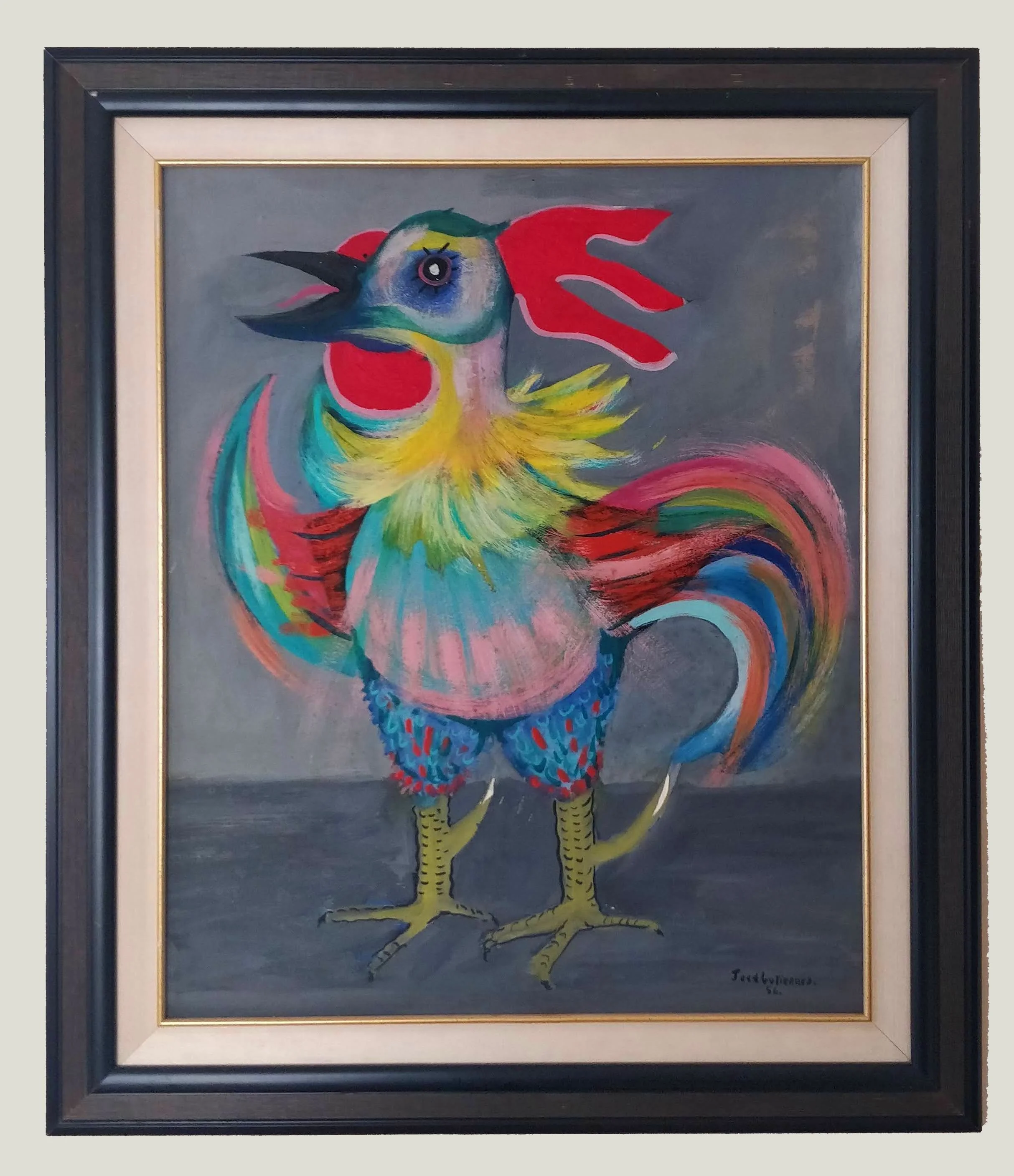
The recent sale by Balboa Park Gallery of this vibrant painting by José L. Gutiérrez offers a perfect opportunity to celebrate a figure whose work transcended the boundaries of art and science.
This particular piece, a testament to the versatility of its materials, is a beautiful example of Mexican Modernism. The stylized form of the rooster, rendered in a high-keyed, almost psychedelic palette of bright pinks, blues, yellows, and reds, captures a dynamic energy. The confident, quick-drying application of the paint, evidenced by the crisp edges and rich textures, is a direct reflection of the pioneering medium used. This unique aesthetic is only possible because of Gutiérrez’s primary contribution to the art world.
The Scientist Behind the Canvas
Unlike many artists who achieve fame through aesthetic innovation, José L. Gutiérrez's profound legacy lies in a chemical breakthrough that changed painting forever. He was a key figures in the creation of the world’s first commercially viable water-based acrylic artist paints.
Gutiérrez's journey began with the radical Siqueiros New York Experimental Workshop, established by Mexican muralist David Alfaro Siqueiros and his principal assistant Harold Lehman in 1936. Operating under a bold manifesto, the workshop declared traditional materials like oil and canvas "archaic," favoring a collective, scientific approach to find "the technique of our time." Here, artists including Gutiérrez were tasked with experimenting exclusively with industrial materials such as automotive enamels and lacquers applied to surfaces like wood panels, making the studio feel more like a chemistry lab or a factory floor.
The workshop became a revolutionary laboratory for technique. The artists, including a young Jackson Pollock, would lay their surfaces flat on the floor, using industrial tools and methods to achieve what Siqueiros called "controlled accidents." They pioneered the technique of pouring, dripping, and splattering paint and then dissolving it with solvents to create complex, unexpected textures and forms. The Workshop was fundamentally dedicated to creating large-scale, public, political art, such as banners and floats for parades, using this revolutionary approach to deliver accessible social messages to the masses.
The Mexican Breakthrough: Politec
Drawing directly from the intense experimentation of the New York workshop, Gutiérrez returned to Mexico with a clear goal. This research culminated in Mexico in 1956, when Gutiérrez introduced Politec Acrylic Artists’ Colors. This innovation was revolutionary because it offered the art world a medium that was:
Fast-Drying: Allowing artists to work with unprecedented speed and layer colors rapidly, as seen in the dynamic brushwork of your sold piece.
Durable: A superior alternative to traditional oil paint for both large-scale murals and easel paintings, offering resistance to light, moisture, and decay.
Versatile: Capable of being manipulated to mimic the thick impasto of oil or the thin washes of watercolor.
Reshaping Mexican and Global Painting

Gutiérrez’s paint was immediately adopted by Mexico's artistic elite. It was the material that allowed the late-stage Mexican Muralists to realize their public, monumental visions, ensuring the longevity of their national masterpieces. He also worked directly with masters of Abstract Expressionism like Gunther Gerzso, formulating specific colors and textures for their intricate, layered compositions.
His influence spread globally, in part through his 1965 instructional book, Painting with Acrylics. This text became a foundational guide that taught artists everywhere how to master the "revolutionary new plastic media."
In an era defined by experimentation and dynamic color—perfectly exemplified by the rooster painting sold by Balboa Park Gallery, José L. Gutiérrez, the paint scientist, provided the essential tool. He didn't just paint; he engineered the future of modern art. His contribution ensures that his name is permanently etched into the history books—not just for the beauty of the works he created, but for the fundamental substance they are made of.